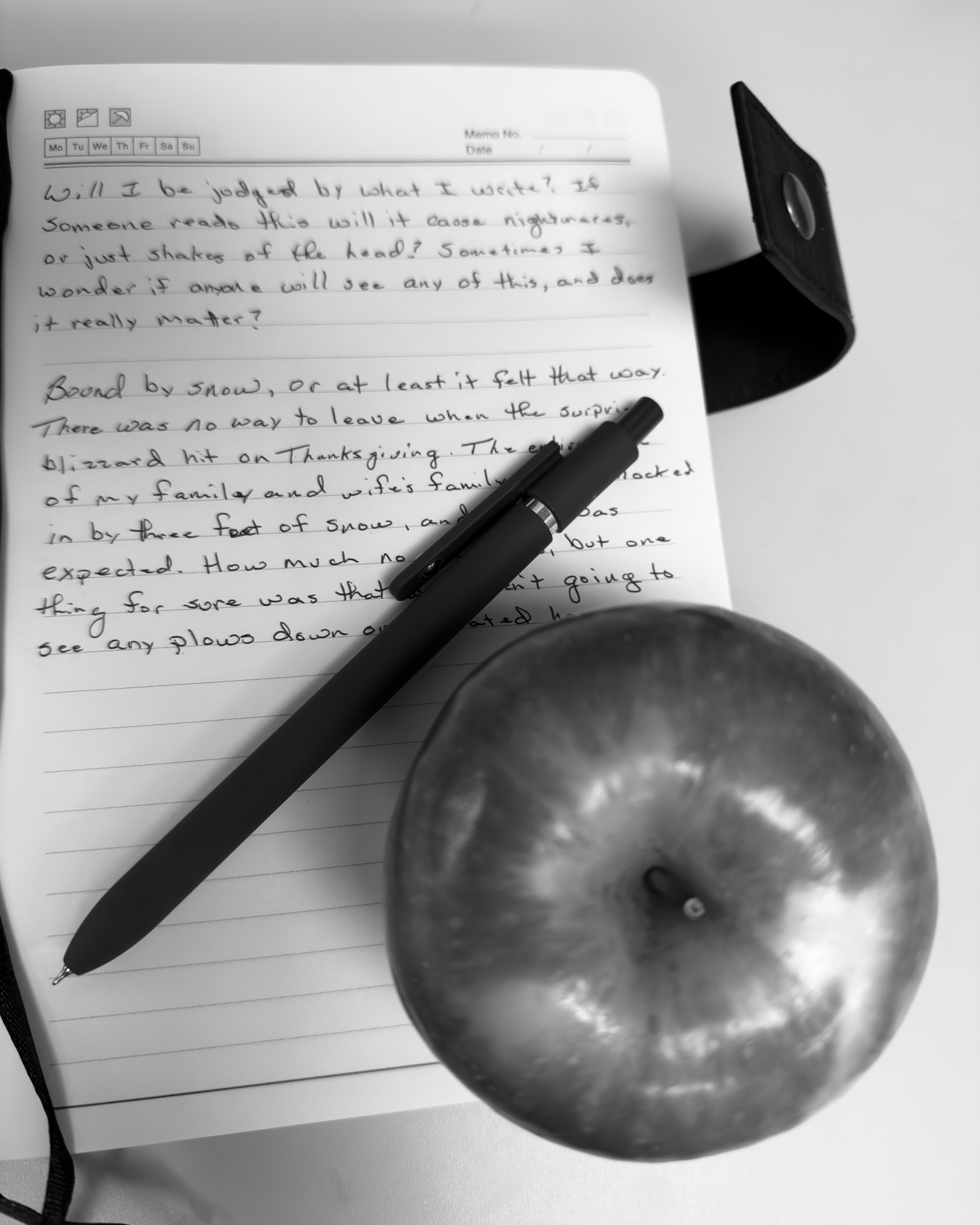
Pip: Born To Write — where rough drafts live in the open, ghosts make candy in 1940, and witches have a very specific approach to marital conflict.
Mara: This episode covers work by Chris Chonos across two territories: fiction in progress — drafts and revisions — and prompted free writing, where the imagination gets to run without a leash.
Pip: Let’s start with the drafts.
Drafts In Progress: Rough And Revised
Mara: Two stories are in the workshop here — one freshly drafted, one pulled off the shelf for a second look. The question both raise is the same: what does a story look like before it’s finished, and is it worth showing that stage?
Pip: The excerpt from The Last Train answers that pretty convincingly. The narrator sets up a grieving, newly sober man on a train platform, and then something quietly off begins to accumulate around him.
Mara: The detail that earns its place: “One woman dressed in dated clothes and is wearing parachute pants for Christs sake and is wearing a walkman with the orange cushions on the head phones.”
Pip: That specificity — parachute pants, orange headphone cushions — does more than period detail. It tells you something is wrong before the story names it.
Mara: The second piece, Short Story in Revising Stage — The Art of Darkness, takes a different approach. A boy with a dark inheritance discovers painting, and the revision question is whether that potential survives the shelf.
Pip: From rough draft to second draft — which brings us to the writing that skips the outline entirely.
Free Writing: Prompts, Ghosts, And Consequences
Mara: Prompted free writing is a different discipline — no plan, just a prompt and wherever the mind goes. The two pieces here show how wide that range can be.
Pip: One lands in genuine magical realism. The narrator crosses an enclosed bridge from a 1940s candy store and finds the original workers still there, still making candy, frozen in the year of a fire.
Mara: The reveal arrives in direct speech: “Welcome to 1940, Chris. We are the ones that make the candy.”
Pip: Six words of exposition and the whole story snaps into focus. That’s a well-placed hinge.
Mara: What makes it work is the accumulation before it — the frosted windows, the period clothes, the worker who shudders and runs. The strangeness earns the payoff. Other Side of the Street is the longer, more developed piece here.
Pip: Then there’s Pay For Betrayal, which goes somewhere darker. A man wakes paralyzed in a dream, and his wife — who warned him she was a witch — is delivering on that promise one nightmare at a time.
Mara: The stakes are explicit: “You will spend your nights making atonement for your betrayal of my husband in the rusty bed.” It’s a prompt piece, but the internal logic holds.
Pip: Prompt writing as consequence fiction. There’s a thesis in there somewhere.
Mara: Across all of it — the drafts, the revisions, the free writing — the throughline is writers showing the work at every stage, not just the finished product.
Pip: Next time, we’ll see where these stories land once the revision is done.
Leave a Reply